The Four People Every Business Owner Needs in the Room
By Craig Lloyd, President & CEO, Glint Advertising
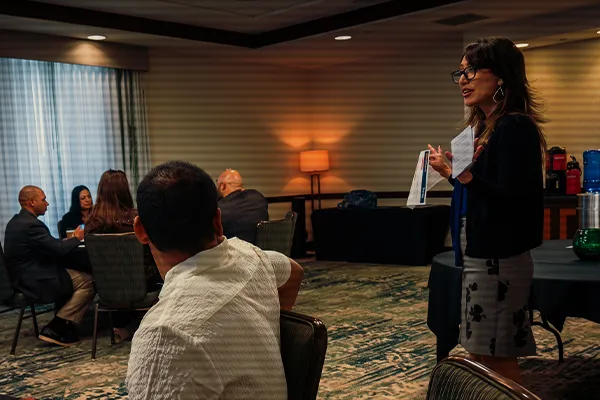
I have attended enough business events over the years to have developed a fairly reliable expectation for what happens inside them. You meet some interesting people, exchange information, hear a speaker or two, and leave with several business cards or digital connections that may eventually become something meaningful. There is nothing particularly wrong with that model, because relationships often begin through exactly those kinds of encounters. What struck me about a recent Access Fort Worth Founders Forum, however, was that Isabel Cabel had assembled something fundamentally different without making a big production of it. She had placed four people in front of business owners who represented four relationships almost every business eventually needs, then allowed the conversation to reveal why having those relationships independently is not nearly enough.
That distinction matters because we have become remarkably good at collecting people while remaining surprisingly bad at connecting them. We call events networking opportunities, build professional networks online, join organizations filled with people who share similar interests, and measure success partly by how many useful people we know. Yet knowing a banker, attorney, CPA, and financial advisor does not necessarily mean those four people understand your business, understand one another, or understand what you are actually trying to accomplish. The collection can look impressive while the connections between everyone remain almost nonexistent. What Isabel created made me wonder whether we have spent too much time thinking about the size of our networks and not enough time considering the architecture behind them.
That is why I hesitate to describe what she is building as networking, because networking does not quite capture what was happening inside that room. It was not about surrounding people with others who think similarly, occupy comparable positions, or appear to be perfect professional matches. It was about understanding people well enough to recognize where they are today, what they might need tomorrow, and who could genuinely help them move between the two. That requires more than introductions, because meaningful connection depends on context, timing, trust, and enough personal understanding to know why two people should know each other. When somebody consistently introduces you to people who somehow make sense before you completely understand why, you eventually realize their connections are working.
Isabel’s own story explains why she approaches those connections with considerably more purpose than most professional organizations typically demonstrate. She described how her grandfather built a successful company that supported his family and created a meaningful legacy, yet his unexpected death exposed something the family had never fully considered. The business had a strong reputation, but the processes, relationships, and structures necessary to continue without him were insufficiently established. By 2026, she explained, the company had disappeared, leaving behind a painful example of how something valuable can become fragile when too much of its strength remains attached to one person. Her interest in connecting business owners with the right advisors therefore comes from something considerably deeper than filling seats at another professional event. As I listened throughout the morning, another idea gradually became difficult for me to ignore.
Most businesses need four professional perspectives almost from the beginning, even though most owners assemble those relationships separately and at completely different stages.
They need somebody thinking about money personally, somebody thinking about money operationally, somebody making the financial story understandable, and somebody protecting the legal structure surrounding everything being built. Those responsibilities broadly fall to a financial advisor, commercial banker, CPA, and business attorney, although the specific professionals and services naturally vary depending on the business. The important insight was not simply in identifying those four seats, because most experienced owners already understand that each discipline eventually matters. The interesting part was imagining what would happen when those four seats became an actual team.
The financial advisor sees what the owner cannot.
Dave Van Buskirk began his discussion with something deceptively simple: get the right team in place around you. He compared strong advisors to coaches who can see blind spots that an accomplished athlete cannot see while performing. That analogy becomes increasingly relevant as businesses mature because experience does not eliminate blind spots and can sometimes make them harder to recognize. Successful owners become extremely knowledgeable about their companies, customers, and industries, but that expertise can create confidence precisely where another perspective becomes most valuable. The right advisor is therefore not merely someone possessing information you lack, but someone capable of seeing what your position prevents you from seeing clearly.
His larger point also challenged the assumption that an advisor who was appropriate five or ten years ago automatically remains appropriate today. Businesses change, personal circumstances change, families change, risk changes, and the definition of financial success can change considerably as an owner moves through different stages. Dave specifically raised the possibility that an owner might have outgrown a banker, CPA, or financial advisor without recognizing that the relationship itself had become a constraint. That idea resonated with me because longevity is usually treated as evidence of a successful professional relationship, even when familiarity has quietly replaced effectiveness.
The better question might be whether the person sitting across from you still understands where you are going and if it has changed.
The banker should be a person before becoming an institution.
The banking discussion exposed another distinction that many business owners probably understand only after experiencing the wrong relationship themselves. A.R. Ruiz emphasized that your banker should not simply be the name appearing on the building, website, or monthly statement. Your banker should be a real person who understands your company, knows how money moves through it, and can help you navigate the institution when circumstances become complicated. His description included not only the primary relationship manager but also the supporting leadership and treasury relationships associated with that banker.
That prompted one of the questions I kept returning to throughout the discussion because my own experience has made the issue difficult to ignore. The person assigned to your business often depends on your current revenue, borrowing requirements, and institutional category, which means the relationship can change precisely when your business begins to change. A company can become too sophisticated for one banking relationship while remaining too small to receive meaningful attention somewhere else. I have experienced situations where the amount we wanted to borrow was actually too small for lenders interested in considerably larger transactions, which creates an odd problem for otherwise healthy businesses.
The institution might possess enormous resources yet still be poorly aligned with what you need at this moment. That is where Isabel’s philosophy of connection becomes more interesting than simply finding somebody with an impressive title. The best banker is not necessarily the banker serving the largest companies, just as the largest institution is not automatically the strongest partner for every business. The better the relationship, the more likely it is that someone understands where your company currently sits, where you want it to go, and what resources realistically fit that journey. Sometimes growth requires moving into a larger relationship, while other situations may actually benefit from somebody operating closer to the business.
Alignment matters more than prestige when the objective is to build something sustainable rather than to gather impressive names around the conference table.
The attorney protects possibilities you may not recognize yet.
Attorneys often enter a business owner’s thinking when something has already happened, which immediately places the relationship into a defensive posture. A contract needs reviewing, a dispute has surfaced, ownership is changing, an employee situation has become complicated, or somebody suddenly realizes an agreement written years earlier no longer reflects reality. Mike Betts's presentation moved the attorney away from that emergency-only position and toward something considerably more useful. His practice focuses heavily on business transactions and succession and legacy planning, which naturally connect legal structure with decisions owners make long before an exit occurs.
That timing changes the value of legal advice because protection becomes more useful when it preserves choices rather than merely responding to problems. An owner thinking about succession, ownership structure, or eventual transition cannot cleanly separate those decisions from taxes, financing, personal wealth, and the operational realities within the company. Even something apparently straightforward, such as a buy-sell agreement, becomes less meaningful when the financial mechanisms required to execute that agreement were never properly established. Dave raised exactly that intersection during his presentation, when discussing agreements that exist legally but may not be adequately funded.
Suddenly, the attorney and financial advisor are no longer occupying separate professional categories because their work begins touching the same outcome.
The CPA tells you what business you have actually built.
Jeremy Johnson’s discussion around accounting, tax strategy, and exit planning brought another dimension into focus because numbers eventually force abstraction into reality. Business owners can describe what they believe their companies are worth, where growth should come from, and what somebody might eventually pay for everything they have created. Financial records eventually tell a less emotional story, particularly when an outside buyer, lender, or investor begins examining several years of performance. Jeremy explained that meaningful exit preparation often begins years before the owner expects to leave, as buyers may review multiple years of financial history when determining value.
His point was not simply that owners should keep cleaner books before selling their companies. Better financial reporting, reduced owner dependence, documented processes, and an understanding of the baseline value can improve the business long before anyone seriously discusses a transaction. That turns exit planning into something closer to business planning, because the characteristics that make a company transferable often make it healthier while the current owner still operates it. A business that can explain how money moves, demonstrate consistent performance, and function without every decision passing through its founder has created options that a completely owner-dependent company does not possess.
When Isabel later asked what I had taken from Jeremy’s presentation, my answer was not really about accounting alone. I kept coming back to the fact that:
The numbers have to make sense across everybody’s responsibilities, because the CPA, banker, attorney, and financial advisor are examining different parts of the same business.
Their responsibilities overlap, their advice affects one another, and decisions made with one professional can create consequences another professional eventually has to address. My question became less about which advisor should handle a particular issue and more about how an owner gets all four perspectives connected around the same objective. That question may have been the most important thing I carried away from the entire morning.

Four advisors do not automatically create a team.
Business owners are accustomed to assembling resources individually because that is generally how professional services are sold and delivered. We hire a CPA for accounting and taxes, choose a banker for deposits and financing, contact an attorney for legal matters, and work with a financial advisor on personal wealth and longer-term financial decisions. Each relationship can be excellent in its own right, yet the overall system remains fragmented. Nobody necessarily bears responsibility for understanding how every decision flows through the other three relationships.
At one point during the discussion, Dave described his discovery process and explained that he asks clients who their banker, CPA, and attorney are. When collaboration becomes necessary, his approach is to work with those existing professionals rather than automatically replace them. That sounds obvious once someone says it aloud, yet many owners have probably experienced exactly the opposite. We become the messenger, carrying information between specialists, attempting to translate advice from one discipline into questions for another, while simultaneously running the company those specialists are supposed to be helping. The business owner becomes the integration system.
That arrangement has always seemed strange because the owner is often the person least qualified to translate among those specialized disciplines. I understand my business extremely well, but understanding my company does not suddenly make me an expert in commercial lending structures, tax planning, estate strategy, or business law. More importantly, I should not need enough expertise in every discipline to recognize when advice from one professional creates an important question for another. The value of having talented people around you should increase when they communicate, because expertise becomes more powerful when someone else can challenge, complement, or contextualize it.
This is where the idea of a personal team becomes considerably more useful than maintaining a collection of professional advisors.
Your team should fit the business you actually want.
There was another element of the conversation that mattered to me because business advice often carries an assumption nobody explicitly acknowledges. Growth is frequently discussed as though every business owner wants the largest company possible, maximum revenue, an enormous exit, and some predetermined version of financial success. I raised the point during the banking conversation that not everybody wants to become a multimillionaire simply because conventional business thinking assumes they should. Some people genuinely enjoy the company they have created, the clients they serve, the people who surround them, and the life that their business allows them to live.
That does not mean those owners lack ambition, because ambition becomes much more interesting when individuals are allowed to define it themselves.
An owner building toward a hundred-million-dollar acquisition needs a different combination of advice than somebody building an excellent ten-person company they hope to operate for another twenty years. A founder hoping to transfer ownership to employees faces different questions from somebody planning to sell to a strategic buyer. Someone building a multigenerational family company requires different structures from somebody whose business exists primarily to support a fulfilling life outside the office. The team, therefore, cannot simply be composed of accomplished professionals, because those professionals must understand the destination before recommending a route.
That may be where Isabel’s instinct for connection becomes particularly valuable because she does not appear to begin with professional categories and work backward toward people. She begins with people, learns enough about their businesses and circumstances to understand where meaningful intersections might exist, then creates opportunities for those intersections to develop naturally. Her introductions throughout the morning repeatedly emphasized trust, genuine care, and a willingness to see another person succeed, rather than relying exclusively on credentials or organizational stature. She even described the group she assembled as a kind of virtual family office, whose members were deliberately chosen because their intentions toward business owners mattered as much as their expertise. That is a very different standard for professional connection.
Connection becomes valuable when somebody understands the context.
A strong connector usually knows a tremendous number of people, but perhaps that definition emphasizes the least interesting part of the skill. Knowing thousands of people creates access, while understanding enough about those people to recognize meaningful alignment creates connection. The second ability requires listening carefully enough to remember what somebody is building, what they value, where they are struggling, and sometimes what they have not yet recognized they need. It also requires resisting the temptation to force every introduction into an immediate transaction.
The best connections I have received throughout my career have rarely arrived with a perfectly articulated explanation attached. Someone I trusted said I needed to meet another person, and eventually the reason became clear in conversation. Sometimes business resulted directly, while other times the relationship produced an idea, perspective, introduction, or friendship that became valuable much later. The connector could see an alignment neither person could see because each of us only possessed our own context.
That ability becomes increasingly valuable in a world where technology can identify similarities almost instantly but still struggles to understand why two imperfectly matched people might matter tremendously to each other.
Perhaps that is also why the phrase “like-minded people” has never completely satisfied me when describing valuable business communities. People who think exactly like I do may confirm what I already believe, but people who understand something I cannot see can change what becomes possible. A banker, CPA, attorney, and financial advisor should not agree automatically because agreement is not the objective of assembling expertise. Their value comes partly from seeing the same decision through different lenses, then caring enough about the owner to work through those differences together. The business owner should remain at the center of that conversation, but should not have to carry it alone.
The room was really the lesson.
By the end of the Founders Forum, I realized the most interesting thing Isabel had created was not contained within any individual presentation. Every speaker offered useful information, but the larger value appeared in the spaces where their advice overlapped. The banker needed good financial reporting from the CPA, while the CPA needed to understand where the owner wanted the business to go. The attorney needed to protect ownership and succession decisions, while the financial advisor needed to understand how those decisions affected the owner and family personally. Each discipline became more useful when viewed as part of a connected system rather than another professional service purchased independently.
That does not mean every business needs these exact four people immediately, nor does it mean the same four advisors should remain forever. The more useful idea is recognizing that businesses develop through stages, and the people surrounding an owner should evolve with those stages. Someone appropriate during the first million dollars of revenue may not remain appropriate at ten million. In contrast, someone designed for a hundred-million-dollar enterprise may provide very little practical value to an owner still establishing basic infrastructure. The challenge is finding people who understand where you are without limiting where you might eventually go.
Isabel understands something about that process that many networking organizations overlook because connection cannot be manufactured through proximity alone. Putting people together creates an opportunity, but understanding them well enough to create meaningful alignment requires considerably more patience and attention. The strongest connector is not necessarily the person who introduces everyone in the room, but the person who knows which people should continue talking after everyone has left.
That morning, four professional disciplines were placed together around a problem every business owner eventually encounters, whether they recognize it early enough or not. We spend years building companies, yet frequently assume that the people who protect, finance, measure, and plan for those companies can operate independently. Then something changes, growth accelerates, an opportunity appears, a crisis arrives, or an exit suddenly becomes real, and we discover that fragmented advice creates fragmented decisions. The better approach may begin much earlier, when there is still enough time to intentionally choose the people surrounding us.
The most valuable professional team may not be defined by having the best banker, CPA, attorney, or financial advisor individually. It may be defined by having four people who understand you, understand where you are going, respect what the others bring to the table, and care enough to work together when the answer falls somewhere between their individual areas of expertise. When you find people like that, you may not immediately be able to explain exactly why the relationships work so well. You simply begin noticing that the right people keep ending up in the room.
Key Takeaways
A financial advisor, commercial banker, CPA, and business attorney become more valuable when their advice connects rather than remaining isolated.
The right professional relationship depends upon where your business is today and what you actually want it to become.
Business owners should not become the sole translators responsible for coordinating every specialized advisor surrounding their company.
Strong connectors understand context, timing, and people well enough to create relationships whose value may not be immediately obvious.
Building a personal advisory team early creates more choices because waiting until an exit, crisis, or major transition limits available opportunities.


