The Business Case for Being Interested in People
Put more than 1,700 professionals in a room, and you would think the opportunity is obvious: meet as many people as possible. That is essentially what we have been taught about networking for years. Work the room, make the introductions, exchange contact information, grow the network, and leave with more people in your orbit than when you arrived.
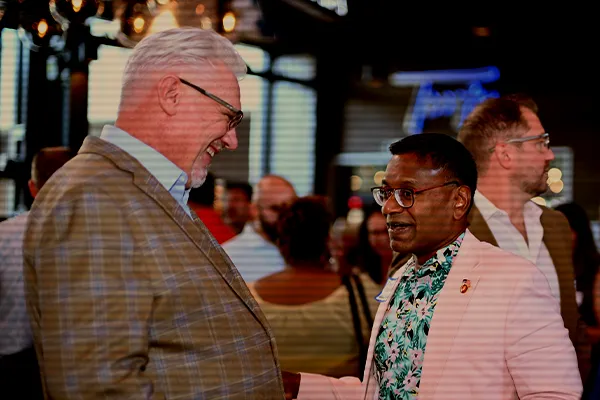
Last night, I went to DallasMeetup at Texas Live!, an event presented by Dallas College and the American Airlines AAdvantage Business℠ Program that brought together more than 1,700 professionals while celebrating the DFW nonprofit community. It was big, energetic, and full of people who had every reason to meet each other. Walking into a room like that after not spending much time at large networking events lately, I wondered whether the sheer size of it might actually work against what I was there to do.
A few hours later, I realized the size of the room wasn’t really the story. The interesting part was what happened as the room started to get smaller. Not physically, of course. It got smaller every time a conversation moved beyond what someone did for a living and into who they were, what they cared about, what they were trying to build, or where life had taken them. Somewhere along the way, 1,700 people became one person standing in front of me, and then another, and another. That is when the evening became valuable. It also reminded me of something I think businesses get wrong about marketing all the time.
We spend an extraordinary amount of energy trying to get people interested in us when there may be considerably more value in becoming interested in them first.
We have solved the mechanics of connecting.
It has never been easier to meet someone. LinkedIn can put thousands of professionals within reach before breakfast. A QR code can transfer contact information in seconds. Digital business cards mean nobody has to remember a name long enough to find a pen, and an event like DallasMeetup can put an extraordinary cross-section of the business community under the same roof for an evening. We’ve solved much of the friction involved in making connections, but I’m not convinced that has made us any better at actually connecting.
There is a difference between acquiring someone’s information and learning something about them. There is an even larger difference between having access to someone and having a relationship with them. The technology is remarkably good at solving the first problem, but the second still requires something decidedly less sophisticated: curiosity, attention and time. That distinction isn’t limited to networking. I see the same thing happen in advertising, sales, leadership and customer experience because businesses naturally begin with themselves. We want customers to understand our products, prospects to recognize our advantages, employees to believe in our vision and audiences to pay attention to our messages.
The question is usually some version of, “How do we get them interested in us?” After last night, I kept coming back to a different question. How interested are we in them?
The conversations I remember weren’t really about business.
The transcript from the evening is almost comical when you look at the range of subjects we covered. Conversations wandered through technology, artificial intelligence, nonprofits, entrepreneurship, financial services, real estate, golf, families, travel, and what people wanted to do with the next part of their lives. At one point, a conversation about technology turned into a discussion about protecting the memory and knowledge behind artificial intelligence rather than becoming dependent on a single platform.

Another conversation started with someone’s technology background and eventually moved across Europe and Asia, family travel, and the importance of exposing children to history and cultures beyond their own. The person I was talking with had lived and worked in multiple countries, and suddenly the conversation wasn’t between two businesspeople at a networking event anymore. It was between two people comparing experiences and talking about the places that had changed the way we saw the world.
I met younger professionals who were still figuring out where they wanted to go, including someone with ambitions of eventually owning hotels and resorts. What stayed with me wasn’t his current job or whether he represented an immediate business opportunity. It was how he talked about where he wanted his life to go, and I found myself genuinely interested in that.
There were also several conversations about nonprofits, which was particularly relevant given the focus of the event. We talked about organizations trying to grow, people attempting to fund missions they care about, and ways businesses like ours can use what we know to help organizations that might otherwise struggle to afford that expertise. Those conversations naturally led into Glint’s philosophy around nonprofit work and our desire to stay connected to the community through it.
Business came up throughout the night, of course. I’m a business owner at a business event surrounded by other businesspeople, so pretending otherwise would make the story less authentic. What interested me was the sequence. The most worthwhile business conversations tended to happen after we had stopped trying to have one. That distinction matters.
Relevance usually comes after curiosity.
Advertising has a relevance problem because businesses often start with what they want to say rather than what someone else might care about hearing. We have a new product, so let’s advertise it. We have a promotion, so let’s send an email. We need more leads, so let’s launch a campaign. We redesigned the company, so let’s tell everyone about ourselves.
None of those things is inherently wrong, but they begin from the organization's perspective. The audience enters the equation later, usually when someone asks who should receive the message or how it should be targeted. A good conversation works in almost the opposite direction.
You meet someone without knowing exactly where the conversation will go. You ask a question, listen to the answer, and notice something interesting. That answer creates the next question, and eventually you understand enough about the person to recognize where your experiences, knowledge or relationships might intersect. Sometimes you know somebody they should meet. Sometimes you’ve dealt with a problem they’re experiencing. Sometimes your company happens to provide something they need. Sometimes there isn’t a business opportunity at all, and the conversation is still worth having.
Advertising should work much the same way. The difference is that advertising doesn’t usually have the luxury of allowing the audience to speak first, which makes listening before we communicate even more important. Research is listening. Customer interviews are listening. Analytics can be a form of listening when we use it to understand behavior rather than merely produce reports. Sales conversations, customer service calls, online reviews, and the questions people repeatedly ask before buying are all ways an organization can learn what matters before deciding what it wants to say.
The creative work should come after that understanding, not before it.
When businesses reverse the sequence, advertising becomes the equivalent of walking into a crowded room, introducing yourself and immediately explaining everything you do. You may find someone willing to listen, but you haven’t given them much reason to care.
There were 1,700 opportunities in the room, but I didn’t need 1,700.
Large events create an interesting temptation because the numbers are impossible to ignore. If 1,700 people are there, it is easy to feel like success should somehow be measured by how many of them you manage to reach before the evening ends.
Advertising has trained us to think similarly. We talk about impressions, followers, database size, website traffic, reach and lead volume because they are visible numbers that fit nicely into reports. More looks impressive, so more easily becomes synonymous with better. The problem is that quantity and value are not interchangeable.
Ten thousand people can see an advertisement without remembering the company behind it. A business can accumulate thousands of email addresses belonging to people who have no interest in hearing from it. Someone can have 10,000 LinkedIn connections and still struggle to name 50 people who would answer the phone when they call.

The more interesting measurements are often harder to capture. How many people stopped and paid attention? How many understood what you were trying to communicate? How many remembered it later? How many conversations continued after the initial interaction? How many people trusted you enough to introduce you to someone else? Thank you, Isabel Cabul and Eknauth Pesuad; you both continuously put others first.
Those questions are harder to put on a dashboard, but they are considerably closer to how relationships and businesses actually grow. The same thing became obvious at DallasMeetup. I didn’t need to meet 1,700 people. I needed to have a handful of conversations worth continuing.
Your reputation is built between transactions.
I’ve always believed relationships should be able to exist independently of an immediate business opportunity. That doesn’t mean ignoring the commercial reality of business. Companies need customers, revenue matters, and business development has a purpose. But there is a meaningful difference between:
Understanding that relationships can create business and treating every relationship as though it owes you business.
Throughout the evening, I found myself talking with people about introductions I might be able to make, people they should meet, and ways we might help each other down the road. In one conversation, we discussed the possibility of connecting successful entrepreneurs who eventually need stronger branding and marketing support. In another, the conversation centered on how someone building a technology company might strengthen their go-to-market approach.
None of that required an immediate pitch. In fact, pushing the business conversation too quickly would probably have made those interactions less valuable, because I would have stopped listening for opportunities to understand the person and started listening for opportunities to sell something. That is where I think many companies unintentionally weaken their brands.
A brand isn’t formed only when someone sees the logo, visits the website, or watches an advertisement. It is being formed when an employee answers the phone, when a salesperson decides whether to recommend the more expensive option, when a company makes an introduction without expecting anything in return, and when someone realizes that the person across the table is actually paying attention.
Those experiences accumulate into reputation, and reputation eventually becomes one of the strongest forms of marketing a company has. Advertising can introduce people to your brand. Their experience with you decides what that brand eventually means.
Maybe we shouldn’t “work the room.”
There is an old phrase associated with events like DallasMeetup: work the room. I’ve never particularly liked it because it makes a room full of human beings sound like territory that needs to be covered. The objective becomes efficiency, which naturally encourages shorter conversations, faster introductions, and more names added to the list. I would rather find a few interesting people and stay in the conversation long enough to discover why they’re interesting.
That may mean spending 20 minutes talking to someone, even though traditional networking advice says you should politely move along after five. It might mean talking about someone’s family, the country they grew up in, a business they’re trying to start, or a ridiculous golf problem before you ever discover what the person could potentially mean to your business. There is some inefficiency in that approach, and I think that is precisely why it works.
What I took away from the evening
There are a few ideas from DallasMeetup that I think are worth carrying back into our businesses:
Stop confusing reach with connection. Being seen creates an opportunity, but what happens afterward creates value.
Become interested before trying to be interesting. Relevance starts with understanding someone else’s world.
Give relationships enough room to become something. Not every interaction needs to produce an immediate commercial outcome.
Pay attention to what happens after the introduction. The follow-up often matters more than the first contact.
Remember that people experience your brand through people. How you make someone feel will often outlast whatever you told them about your company.
Technology will continue making introductions easier. We will become better at finding audiences, identifying prospects, automating communication, and putting thousands of potential relationships within reach. Artificial intelligence will accelerate much of that even further. That doesn’t make human connection obsolete. I think it makes it more valuable.
When everyone can reach everyone, access becomes less differentiating. When everyone can generate more content, emails, and messages, volume becomes less meaningful.
The advantage begins shifting toward something technology has always struggled to manufacture convincingly: genuine interest in another person.
The real work starts the next morning.
Toward the end of the evening, we started talking about what would happen afterward. There were people to connect with on LinkedIn, conversations to continue, and meetings already taking shape. I remember saying that I would reach out to everyone I had met because the event itself was really just an introduction. That may be the most important part of the entire experience.
The real test of networking isn’t what happens while you’re standing in the room. It is whether you remember what mattered to someone after you leave. Do you make the introduction you promised? Do you schedule the lunch? Do you send the information you discussed? Do you continue the conversation without immediately turning it into a sales call?
Advertising faces the same test. Getting someone’s attention is not the finish line. A click isn’t a relationship. An impression isn’t trust. A lead isn’t a customer. Each is simply permission to continue the conversation, and what the organization does with that opportunity determines whether the connection becomes meaningful.
If you’re responsible for marketing, sales, or leadership inside your organization, this is worth discussing with your team. Ask whether you’re primarily creating more opportunities to contact people or creating more reasons for people to stay connected with you. Those are not the same thing, and the distinction becomes more important as technology makes the first one increasingly easy.
Share this article with someone who approaches business relationships differently than you do and compare notes. I’d also like to hear about the business relationships that became unexpectedly important in your career, particularly those that began without either person knowing where the conversation might lead.
There were more than 1,700 people at Texas Live! last night. I couldn’t possibly meet all of them, and I didn’t need to. The opportunity was never to meet everyone in the room. It was to leave knowing a few people better than I did when I walked in. And maybe that is a pretty good way to think about advertising, too.


