Marketing Camp Recap: AI, Trust, and the Future of Marketing
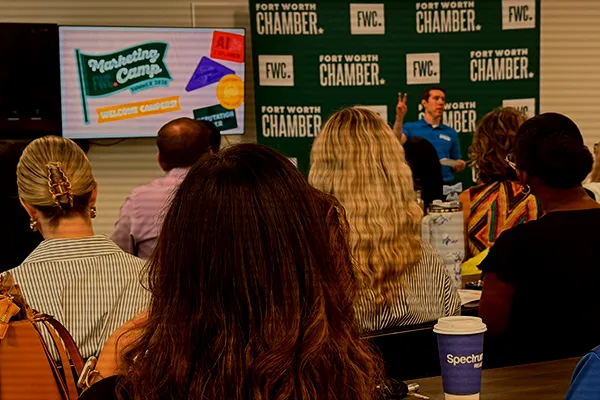
The room was already full when the Fort Worth Chamber’s Marketing Camp began. Marketers, business owners, nonprofit leaders, communications professionals, and agency teams filled the tables with laptops, notebooks, coffee cups, and the familiar expectation that accompanies any professional development event. Everyone came prepared to learn something they could bring back to work. A better tool. A clearer strategy. A new approach to artificial intelligence. A practical idea capable of improving the next campaign.
The camp theme created a lighter atmosphere than most business conferences. Speakers were framed as camp counselors. Sessions took place in classrooms throughout the building. Attendees were encouraged to divide, conquer, compare notes, and make new friends when conflicting sessions made it impossible to attend everything. The environment gave people permission to participate rather than remain passive observers. That mattered because the strongest sessions were not simply presentations. They asked the audience to think, debate, solve problems, and apply ideas while the information was still fresh.
Marketing Camp also reflected the reality of modern marketing. No single session could fully explain where the industry is headed because the work now spans nearly every part of an organization. Marketing involves technology, reputation, customer experience, crisis communication, data, leadership, sales, brand strategy, public relations, and organizational clarity. The event did not attempt to force these disciplines into one narrow definition. Instead, it offered a range of sessions that showed how closely connected they have become.
Technology may change how trust is discovered, but it does not remove the responsibility to deserve it.
Three sessions especially captured that connection. One examined how artificial intelligence is changing search, content, and public relations. Another rebuilt the traditional marketing funnel around the actual customer journey. A third-place attendee was placed inside a fictional crisis and asked to communicate without complete information. Each addressed a different subject, yet all three eventually arrived at the same business reality. Organizations earn trust through clarity, consistency, preparation, and experience.
AI Is Turning Search Into Recommendation
Keynote Speaker: Lauren Kwedar Cockerell
The session examining artificial intelligence and public relations began with an ordinary personal story. The speaker needed to choose something appropriate for a family birthday celebration that involved several generations and diverse preferences. A few years ago, that process might have started with a Google search followed by restaurant websites, reviews, and menus. Instead, the speaker launched an artificial intelligence platform, explained the situation in a conversational tone, and asked for a recommendation.
That small behavioral change illustrates a much larger transformation. People are no longer entering a few keywords and reviewing a long list of links. They are describing problems, circumstances, preferences, concerns, and desired outcomes. The artificial intelligence platform then interprets those details and returns a smaller set of recommendations. The difference between search and recommendation is substantial. Search presents possibilities. Recommendation narrows them. Search asks the user to evaluate the available information. Recommendation performs part of that evaluation before the user ever reaches a company’s website.
The presenter illustrated this with a business-to-business example. Imagine an operations leader at a growing e-commerce company that has outgrown its current supplier. That person may not search for a generic phrase such as “manufacturer in North Texas.” They may explain that the company is growing quickly, needs custom capabilities, requires dependable turnaround times, and cannot risk working with a vendor that disappears when volume increases. The question becomes more human and more specific: “Who should we talk to?”
Artificial intelligence may then provide only a few names with explanations for why each company appears relevant. By the time a prospect contacts one of those companies, part of the selection process has already occurred. The organization has either entered the short list or remained invisible without ever knowing the conversation happened. This shift creates a new challenge for marketers. A company can no longer focus solely on whether its website appears in a search result. It must consider whether artificial intelligence can confidently understand the company, categorize its expertise, connect it to a specific need, and justify recommending it.
That confidence is built from more than website copy. Artificial intelligence considers information from across the digital environment, including articles, reviews, directories, interviews, awards, podcasts, social content, and other third-party sources. A company’s owned content still matters because it explains the business directly. However, what other credible sources say about the company can have tremendous influence because those sources help validate the company's claims about itself. This is where public relations becomes increasingly relevant to search engine optimization. Public relations has always helped organizations build and manage their reputation. In an artificial intelligence environment, that reputation becomes data. Meaningful media coverage, respected awards, credible directories, client recommendations, industry interviews, and expert commentary create outside signals that machines can evaluate alongside human readers.
The session also challenged the assumption that producing more content automatically improves visibility. Artificial intelligence has made content production easier, enabling nearly every company to publish more often.
Volume is no longer a meaningful distinction when competitors are using similar tools, prompts, structures, and vocabulary.
In fact, more content can create a larger problem when it is inconsistent. A website may position the company one way, LinkedIn may communicate something different, and outsourced blog content may introduce an entirely separate interpretation. Rather than consolidating all that activity under greater authority, artificial intelligence may recognize the contradictions and move toward a company it can understand more easily.
The problem is rarely limited to writing. Inconsistency usually reveals that the organization has not made clear strategic decisions about who it serves, what it believes, what makes it different, and what outcome it is best equipped to create. When leaders avoid specificity because they fear excluding an opportunity, they often make the organization too generic to remember. Artificial intelligence may struggle to categorize a generic company, but people have the same problem. A message broad enough to apply to everyone rarely creates urgency for anyone.
The speaker offered a simple test. Review something the company published during the previous ninety days and ask whether a competitor could have published essentially the same message. When the answer is yes, the content may be filling a calendar without strengthening a position.
The alternative begins with the company’s story rather than the content schedule. The session presented a staged process that starts by determining what the organization actually believes and what makes it meaningfully different. From there, the company identifies the central narrative running through its work, builds the messaging architecture around that narrative, and then activates it consistently across the places where people and artificial intelligence encounter the brand. Positioning, proof points, stories, terminology, and audience definition must align before the organization begins producing more material. Activation is the final stage, not the first. Publishing without that foundation simply distributes uncertainty faster.
This does not mean every organization needs a separate website exclusively for artificial intelligence. It does mean content should be structured so machines can retrieve and interpret it. Clear headings, direct answers, consistent language, specific expertise, useful questions and answers, named services, geographic relevance, case studies, and credible supporting evidence make the organization easier to understand.
The session’s strongest idea was not that artificial intelligence has changed everything. Artificial intelligence has exposed weaknesses that already existed. Companies with unclear positioning, inconsistent language, generic content, and limited outside credibility were difficult for people to understand long before machines began making recommendations. Artificial intelligence simply makes clarity more valuable and confusion more expensive.

The Marketing Funnel Is a Customer Journey, Not a Collection of Tactics
A separate two-part session focused on the marketing funnel and the reasons many marketing efforts fail. The presenter began with a statement heard regularly from business leaders: “We tried that, and it did not work.” The tactic may have been search advertising, social media, email, direct mail, video, radio, sponsorships, public relations, or another channel. The conclusion is often immediate. The organization tried the tactic, did not receive the desired result, and determined that the tactic was ineffective.
The session challenged that conclusion by asking a better question. What role was the tactic expected to perform?
A billboard may raise awareness, but a company may judge its success by the number of immediate phone calls it generates. Social media may create engagement, but leadership may expect it to close complex business-to-business sales independently. A website may provide consideration-stage information, but the sales process may fail after the prospect submits a form. In each case, the tactic may be blamed for an outcome it was never designed to produce.
The presenter organized the customer journey into five connected stages: awareness, engagement, consideration, conversion, and loyalty. Awareness introduces the organization. Engagement creates interest and interaction. Consideration builds confidence as the prospect compares options. Conversion removes the final obstacles to action. Loyalty extends the relationship, encourages referrals, and increases customer lifetime value.
This may appear simple when presented on a screen, yet many organizations treat each stage as a separate marketing activity rather than as part of a single system. Different employees, agencies, vendors, and platforms may control different pieces without sharing information. The awareness campaign may promise one experience. The website may create another. The sales conversation may introduce a third. The customer then encounters an onboarding process that no longer resembles what initially attracted them. The funnel is not valuable because it gives marketers another diagram. It is valuable because it forces an organization to examine what customers experience between first awareness and long-term loyalty.
The work begins with the audience. The presenter encouraged attendees to distinguish between the people most likely to need the company’s solution and a secondary reach audience that may require more education or a different message. The central question is not merely who the audience is demographically. It is what problem occupies that person’s mind and how the organization improves that person’s life, work, business, or future.
Once that is understood, awareness tactics can be judged appropriately. Sponsorships, events, media, print, outdoor advertising, search visibility, and community involvement may introduce the organization to audiences without generating immediate revenue. Their role is to create recognition among the right people. Measuring them solely by last-click conversions can undervalue the work they perform earlier in the decision process. Engagement begins once people recognize the organization, but are not prepared to choose it. They may watch a video, read an article, save a post, join a group, open an email, attend an event, or return to the website. These actions indicate developing interest rather than completed intent.
The session emphasized that engagement should be measured by the quality of interaction, not the appearance of popularity. A large audience with little participation may be less valuable than a smaller audience that consistently responds, saves, shares, asks questions, and enters conversations. The presenter also recommended pairing video with transcripts and summaries, allowing human audiences to consume the content visually while giving search and artificial intelligence systems structured text they can interpret.
Consideration begins when the prospect is actively evaluating options. At this stage, broad brand messages are no longer enough. People need useful evidence that can reduce uncertainty. Case studies, calculators, planning tools, guides, comparison information, testimonials, email sequences, and retargeting can help the prospect understand why one organization is the stronger choice.
Conversion is the point where friction becomes especially costly. A company may invest heavily in awareness and consideration, only to make the final action confusing. Contact information may be difficult to find. Scheduling may require a phone call when the customer prefers online booking. The checkout process may lack familiar payment options. A proposal may provide no clear next step. A qualified lead may reach an employee who is unprepared to respond. This part of the session was particularly important because marketing cannot be evaluated independently from sales and operations. Call tracking, customer relationship management, lead handling, and quality control help organizations understand what happens after marketing creates the opportunity.
When a promising lead disappears, the problem may not be the campaign. It may be the experience that followed it.
The final stage, loyalty, is often the most neglected. Many organizations invest heavily in acquiring customers and then reduce communication once the transaction occurs. Marketing hands the relationship to sales or operations, and attention shifts back toward finding someone new. The presenter argued that customer lifetime value provides a more accurate view of growth. The value of a new customer is not always the revenue from the first transaction. It may include years of repeat business, expanded services, referrals, reviews, recommendations, and introductions. Retaining the right customer can produce more value than repeatedly replacing customers who were never meaningfully developed. The session did not argue that every company needs every tactic. It argued that every chosen tactic needs a reason.
Crisis Communication Reveals the Organization Behind the Brand
Crisis Camp approached marketing from a completely different direction. Instead of explaining a framework first, the presenters placed attendees inside a fictional emergency. The Fort Worth Chamber leadership team had left for a wilderness retreat in West Texas. No calls, emails, or social posts had been received since the previous day, and the group had missed a scheduled check-in. Concern increased when a prominent member publicly asked whether anyone had heard from the leadership team.
The attendees were divided into crisis communication groups and asked to determine what should happen during the first hour. Who needed to be contacted? What should employees be told? Should the organization respond publicly? What could be said when the facts remained incomplete? The lack of information was intentional. Real crises rarely arrive as complete stories. Details emerge gradually, sources conflict, audiences demand answers, employees speculate, reporters call, and social media fills the silence. The exercise forced participants to make decisions while the situation continued to change.
The strongest lesson was that waiting for perfect information can become its own form of communication. When an organization says nothing, the public does not necessarily pause. Other people begin creating explanations. Rumors become narratives. Screenshots circulate without context. Unofficial comments are treated as official positions. Artificial intelligence now raises another concern: convincing statements, documents, images, and press releases can be fabricated quickly.
A responsible initial statement does not need to answer every question.
The presenters repeatedly returned to the need for calm, composure, empathy, and clarity. People want to know their concerns are being heard and the situation is being treated seriously. They do not require an organization to know everything immediately, but they expect honesty about what is known, what remains unknown, and what will happen next. Internal communication must also receive priority. Employees, board members, partners, and key stakeholders should not discover an organizational crisis through social media or television coverage. They need timely information, clear instructions, and a shared understanding of who is authorized to speak. Without that direction, well-intentioned people may intensify the problem. An employee may answer a reporter’s question informally. A board member may post personal commentary. A partner may repeat unverified information. Each action expands the crisis and makes the organization appear less coordinated.
Preparation creates the discipline needed to avoid that confusion. Organizations should determine the crisis team, decision authority, spokesperson, approval process, employee instructions, stakeholder contacts, communication channels, and backup responsibilities before an emergency occurs. Contact lists must be current. Access to websites and social accounts cannot depend on one unavailable employee. Draft templates can provide a starting point, although every message must still respond to the specific facts and human consequences involved.
The organizations that navigate crises effectively are rarely the ones capable of writing the cleverest statement after the event begins. They are the ones who have built trust before the crisis, prepared while conditions were calm, and created a culture in which people know how to respond under pressure.
What the Event Ultimately Reinforced
Artificial intelligence, marketing funnels, and crisis communication may appear to occupy different corners of the profession. At Marketing Camp, they revealed themselves to be part of the same responsibility.
The artificial intelligence session showed that organizations must be clear enough to understand and credible enough to recommend. The funnel session showed that marketing must guide people through a complete experience rather than produce disconnected activity. Crisis Camp showed that trust depends on how an organization communicates when control and certainty disappear.
Each session moved beyond promotion. Each asked whether the organization behind the marketing was prepared to support the promise it was making.
That may be the most important direction for the profession. Marketing is not becoming less creative, but creativity alone is insufficient. It is not becoming less technical, but technology alone does not create meaning. It is not becoming less human, even as machines play a larger role in discovery and decision-making.
The tools will continue changing. Search will evolve. Artificial intelligence platforms will improve. Channels will rise and decline. Customer expectations will shift. New crises will arrive through technologies that do not yet exist. The enduring responsibility is to understand people, clarify what the organization stands for, build systems that support the customer journey, communicate consistently, and earn the trust that marketing can only begin to build.
Marketing Camp provided plenty of tactics to take back to work. Its greater value was reminding the room that tactics become meaningful only when they serve a clear business purpose.


